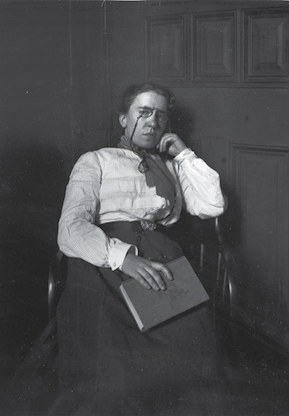
Goldman in 1906, photographed for the Chicago Sun-Times.
Goldman in 1906, photographed for the Chicago Sun-Times.
Emma Goldman (1869-1940) was an anarchist thinker and revolutionary, a radical champion of workers, women, and the anti-capitalist revolution. Imprisoned for inciting riot, blamed for the assassination of William McKinley, deported in the first Red Scare, called the High Priestess of Anarchy, the Red Queen, the most dangerous woman in America—she was one of the most prominent and feared radical thinkers of her age.
Born in the Russian Empire to a straitened Orthodox Jewish family, Goldman educated herself on the revolutionary literature of those turbulent times. She immigrated to Rochester, N.Y. at 16, where she worked over ten hours a day as a seamstress and read the radical journal Die Freiheit at night, attending German socialist meetings in what time was left. She soon grew disillusioned with the inhumane conditions of the American worker. When four Chicago anarchists were wrongfully convicted and executed for the Haymarket affair, she left an unhappy and short-lived marriage, packed up her life, and moved to New York City to become a revolutionary.
On her very first day in the city, she would meet both Johann Most, Die Freiheit editor who would become a mentor and then a rival, and Alexander Berkman, who would become a lifelong companion in love, friendship, and revolution. Goldman and Berkman, together with Modest "Fedya" Stein, the third member of their commune and ménage à trois, planned an attentat—a direct action, a "propaganda of the deed" designed to rouse the public to revolution—in response to the bloody repression of the Homestead steel strike. Their target was industrialist strikebreaker Henry Clay Frick. Berkman would shoot the man; Stein would dynamite his house, as a failsafe; and Goldman, who raised the money for the gun, would stay behind and provide the propaganda to Berkman's deed.
The plot was a bust. Frick didn't die, despite being shot twice and stabbed three times; nearby workers, far from joining the attentat, wrestled Berkman to the ground; the Homestead strikers denounced the act; Berkman was sentenced to 22 years. This failure, combined with her later experiences in Bolshevik Russia, would lead Goldman to a more qualified endorsement of violence as a revolutionary tactic. She never wavered, however, in her conviction that violence was a revolutionary necessity. "They were doubts, after all," writes Alix Kates Shulman, "about the methods of but not the need for revolution" (Red Emma Speaks, 254.)
Her own arrest and year-long imprisonment soon thereafter, for "inciting to riot" in the speech presented p. 7–8 of this book, cemented her national notoriety. It was the first of many political arrests. Upon release, Goldman was in immediate demand on the lecture circuit, at home and abroad—celebrated, vilified, and unceasingly interviewed.
In 1901, self-avowed anarchist Leon Czolgosz shot and fatally wounded sitting U.S. President William McKinley. Despite being wholly unconnected to the plot, having previously assumed Czolgosz an infiltrator, Goldman and many of her milieu were arrested and charged as accomplices. She was released after two weeks.
The episode, however, as well as her refusal to condemn Czolgosz (see this book, p. 70: "Poor Leon Czolgosz, your crime consisted of too sensitive a social consciousness") led her to go to ground, isolated and fearful of her safety.
She emerged to fight the Anarchist Exclusion Act that would ultimately be pivotal in her own 1919 deportation, re-entering the public stage in earnest with the 1906 launch of her Mother Earth. The anarchist monthly and its publishing wing became a platform for her broad-ranging ideas: on anarchism, Bolshevism, the women's emancipation movement, art, religion, birth control, marriage, prisons, education. Ideas she also promulgated around the country on a non-stop, decade-long speaking tour that funded the periodical while the released Berkman kept it running. It was Mother Earth that first published her 1910 Anarchism and Other Essays, a collection born of her disillusionment with the spoken word as a vector for change.
It was their anti-draft activism that would ultimately see them deported. Charged with conspiracy and imprisoned for two years—during which Goldman of course agitated with fellow political prisoner, socialist Kate Richards O'Hare, for better conditions—Berkman and Goldman were released in 1919, at the height of the first Red Scare. They became the most prominent targets of J. Edgar Hoover's career-making political deportations.
They arrived in Russia, along with 247 others, just as the Bolsheviks were consolidating power. Though previously a stalwart supporter of the Russian Revolution, Goldman quickly grew disillusioned with the new regime's inequalities, suppression of free speech, and, especially, its brutal quelling of the Kronstadt rebellion. She and Berkman left for Latvia. Their subsequent criticism of the Soviet Union would alienate them from much of their milieu.
She spent the next decade in exile, having parted ways with Berkman in Berlin, eking out a living by writing and lecturing across Europe. When she found herself facing yet another deportation, this time from England, she entered an amicable marriage of convenience with Scottish coal miner and anarchist James Colton. Citizenship secure, she joined Berkman in Saint-Tropez and wrote her 1931 memoir, Living My Life. Its positive reviews marked a soft closure to her reputation as a truly dangerous subversive. Anarchism had lost its teeth, a distant relic in the new political landscape of rising fascism. Goldman was allowed back to the U.S. for a lecture tour, provided she speak only on the book.
Alexander Berkman, destitute and ill, killed himself June 28, 1936. The largely anarchist Spanish Revolution broke out July 19. "The crushing weight that was pressing down on my heart since Sasha’s death left me as by magic," Goldman wrote upon being invited to the barricades of Barcelona. For the next four years, she would tour their collectives, edit their bulletins, answer their English-language mail, and agitate on their behalf across Europe and North America.
At 70 years old, Emma Goldman suffered a stroke and died while raising funds in Canada for her comrades in Spain. Finally allowed to return to the U.S., she was buried in Chicago, near the Haymarket martyrs.
For more on Emma Goldman and political violence, see:
Ferguson, Kathy E. "Discourses of Danger: Locating Emma Goldman." Political Theory 36, no. 5 (October 2008): 735–61.
Léa Gauthier, ed. and trans. Il nous faut être prêts à chaque instant: Sur la violence politique. Paris: Éditions Payot & Rivages, 2023.
Redding, Arthur. " The Dream Life of Political Violence: Georges Sorel, Emma Goldman, and the Modern Imagination." Modernism/modernity 2, no. 2 (April 1995): 1–16.
Shulman, Alix Kates. "Preface to Part Three," In Red Emma Speaks: An Emma Goldman Reader, edited by Alix Kates Shulman, 251–55. New York: Humanity Books, 1998.
For Goldman's later views on political violence, see:
Goldman, Emma. My Disillusionment in Russia. Garden City, NY: Doubleday, Page and Co., 1923.
Goldman, Emma. My Further Disillusionment in Russia. Garden City, NY: Doubleday, Page and Co., 1924.